Welcome!
Our decade-long blog is a rich resource for teachers and parents.
Explore scores of hands-on activities for middle-grade kids, each connected to a delightful book.
Welcome!
Our decade-long blog is a rich resource for teachers and parents.
Explore scores of hands-on activities for middle-grade kids, each connected to a delightful book.
SIGNING OFF
by Brandon Marie Miller
Dear Blog Peeps,
Well, it's time. I can't believe our very first post was over ten years ago! And now, after nearly 100 blogs, we are saying goodbye to new material on Hands-On-Books. Thank you to everyone who has read, commented, and shared our blog!
Happily, ten years of goodness remains for kids and adults, teachers, librarians, and parents to find-- great articles about history, STEAM, and a wide-range of activities to meet any interest. We would especially like to thank our guest bloggers over the years who have shared their passions, expertise, and books. Please continue to browse our archives and see what you discover.
I want to thank Mary Kay Carson and Kerrie Hollihan for joining me on this journey and for their friendship and support over the years. We have loved being part of Hands-On-Books!
For my last activity, I'm leaving you my favorite holiday recipe. It's my Aunt Marty's cheeseball, a recipe from the 1950s, and has some original ways of giving measurements. It's part of my earliest Christmas memories, going to my aunt's home on Christmas Eve, seeing all the cousins, everyone dressed up, exchanging gifts, and laughing at the family "talent" shows.

My family still looks forward to this cheeseball every year, and between my house and my sister's house, we devour several. We sometimes wonder why we don't make it other times of the year. But it is so much a part of our family's Christmas celebrations, that it would just seem weird making one outside the month of December!
What holiday favorite recipes does your family look forward to each year?
AUNT MARTY'S CHEESEBALL
 |
| The recipe Marty typed up for me. |
1 jar Kraft Old English spread
Blue cheese (size of a golf ball)
Grated onion (size of a ping pong ball)
Chopped fresh parsley
Chopped pecans
Mix cheeses, onion, and some parsley (a mixer makes this easy.) Roll the cheese mixture in chopped parsley and pecans (you can spoon the pecans and parsley around and over the cheese to get started) then shape into a ball. This is messy, but worth it!
Cover with foil and refrigerate to set up. Serve with assorted crackers. ENJOY!
Welcome this month's guest blogger, Heather L. Montgomery*!
Round rocks, red leaves, rhinoceros beetles—we all know that kid who would cram them in a pocket then clutter up the closet. . . That kid might be a scientist. George Washington Carver, Jane Goodall, Charles Darwin—all were incessant collectors as kids!

Kids can build permanent collections, seeking out just the right thing to fit a category and taking care to find the perfect specimen, but there’s lots of fun to be had in quick collections, too. On your next outing, why not put your pocket-packing skills to the test?
Alphabet Mess: Quickly collect 30 or more random items into a pile. Then turn the mess into a tidy alphabetical line. Can you make a complete alphabet?
Categories: Call out a category (nut, something orange, something ancient, once living thing, something fuzzy, something smelly, etc.) and see what everyone finds. Bring the artifacts together to compare/contrast. For easy display of small items, use a white ice cube tray. In addition to the stated category, what else do those items have in common?

Collection Connections (left): Make a grid on a piece of paper (adjust size according to your needs). Place one artifact in the center square. Any collected item can be added to an adjacent square if you can name one way in which the items connect. For example, they could both be animal parts, one (a plant) could use another (soil), they could both provide shelter, they could be the same color, texture, shape,… For an extra challenge, add an item and let others guess the connection.
*Heather L. Montgomery writes for kids who are wild about animals. An award-winning author and educator, Heather uses yuck appeal to engage young minds. Her books include: Something Rotten: A Fresh Look at Roadkill, Bugs Don’t Hug: Six-legged Parents and Their Kids, and What’s in Your Pocket? Collecting Nature’s Treasures. Learn more at www.HeatherLMontgomery.com

This is my final post for Hands On Books. Brandon, Marry Kay and I are closing up shop for this blog at year’s end.
I cruised through my offerings since 2013, when we opened shop to generate interest in our books and what we have written. Book author guru Jane Friedman advised us to make our blog “useful,” and by offering kid-centered activities, I think we’ve accomplished that! Jane’s primo blog, “Electric Speed,” is at https://www.janefriedman.com/


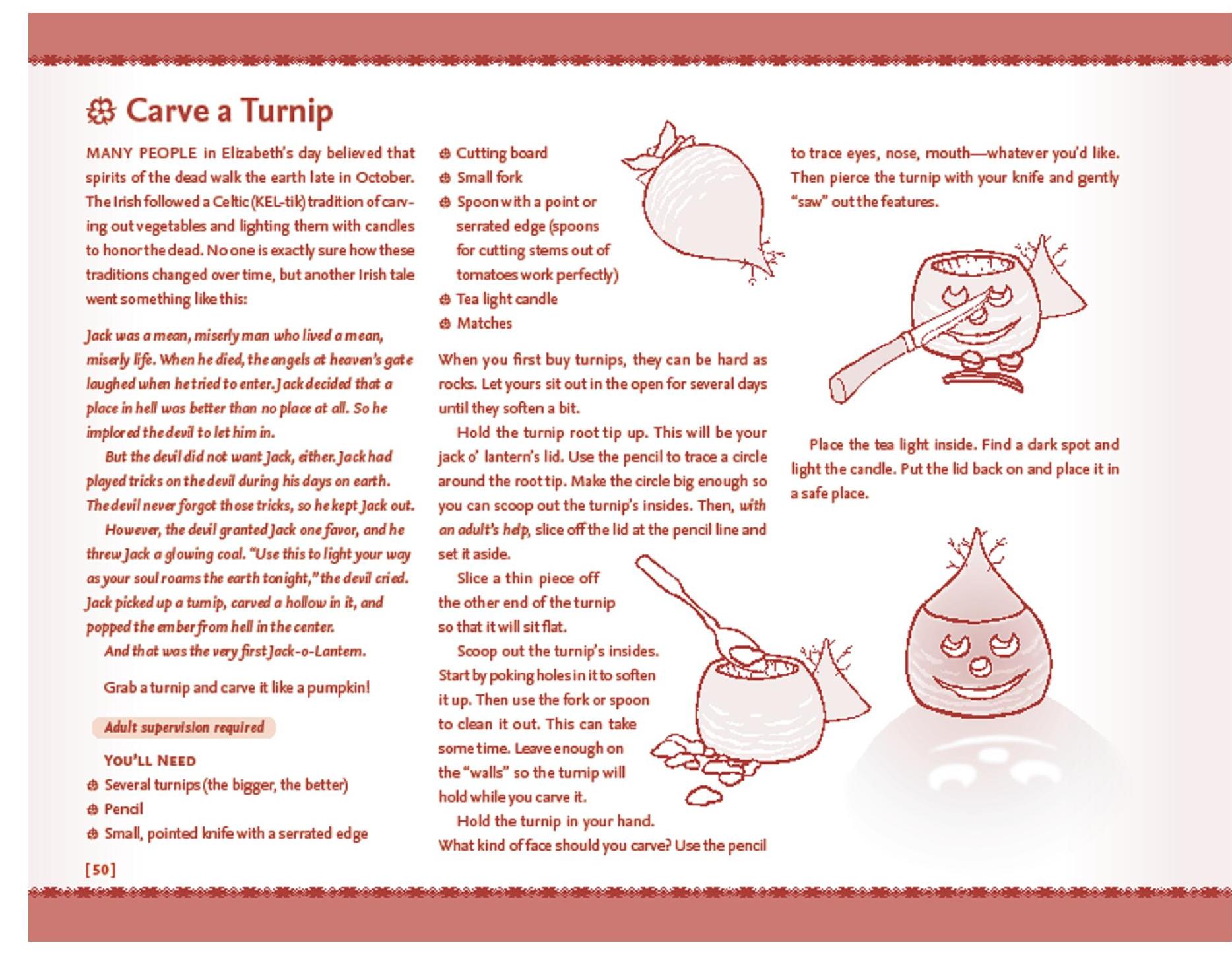
I’m regenerating one of my favorite posts in honor of the month of October—how to carve a turnip! Celtic people in the British Isles carved these root vegetables in the fall festival of Samhain (SOW ren), the time of year when the veil between our world and the spirit world is at its thinnest. (That post is here: https://bit.ly/2YjqNzq )
*Authors aren't supposed to say "Buy my book," but that's a story for another day...

Welcome this month's guest blogger, Rebecca Hirsch*!
Fall is coming. Maybe you’ve noticed it too—a chill in the air, leaves starting to turn, darkness arriving earlier in the evening. It's perfect time of year for an outdoor exploration of the dark and its animals with my new picture book, Night Creatures: Animals That Swoop, Crawl, and Creep while You Sleep.

You can stay up late one night, maybe in a park or other secluded setting, and see if you can spot animals waking up around you. These animals may be nocturnal (active only at night) or crepuscular (active only at dusk or dawn). You can learn to identify night creatures even if you can’t see them clearly.
You’ll need: ✔ flashlight ✔ piece of red cellophane or a red sock
Cover the lit end of the flashlight with cellophane or the sock so the light comes out red in color. Red light won’t ruin your own eyes’ adjustment to the dark, and many night creatures do not see red light and so they will not be disturbed by it.
Here’s what you can look for during a night outdoors:


How many of you are currently watching the Tokyo Olympics? Me! <waves hand wildly>
I LOVE sports. I should. I grew up with three brothers and a father who love sports. It was natural that I would as well. After all, I spent most of my days playing baseball in the backyard with my brothers, shooting hoops in the driveway, swimming laps in the pool for swim practice, running, hiking, biking, etc. You name it, I’ve played the sport.

In my The Secret Science of Sports: The Math, Physics, and Mechanical Engineering Behind Every Grand Slam, Triple Axel, and Penalty Kick (August 2021, Black Dog & Leventhal), my recipe for a great book is --> STEM + Sports = GREAT FUN!
Hold on. There is one thing you should know. This book is not meant to be read sitting down. I want readers to DO the STEM with the sports. To SEE and EXPERIENCE the science, technology, engineering, and math in every sport.
TRY OUT these three challenges from the book:
You’ll need: • soccer ball • balloon


It’s also a PERFECT guide to the 2021 Olympics. (Hint: this book even breaks down Simone Biles’ famous flip—it’s on page 159.)
Have a great summer! Go STEM and SPORTS!
🏀 🏆 🎾

When Hillary Clinton won the Democrat nomination for US president in 2016, many thought that she was the first woman so honored.

Welcome guest blogger Jenna Grodzicki!

My newest book, Wild Style: Amazing Animal Adornments, features 11 animals that decorate themselves in order to survive. Doing the research for this book was a blast! These wacky adornments help the animals stay safe from predators, protect their bodies, show power, make it easier to find a mate, or allow them to sneak up on their meal unseen.

One such animal is the flamingo. The flamingo spreads oil all over its feathers. This oil is produced in glands near its tail. The oil keeps the flamingo’s plumage waterproof and improves its durability. But how does this actually work? The activity I’ve provided below will show students exactly how the oil does its intended job.


Happy spring, everyone! My just-released latest book Animal Watching is the perfect companion to warmer weather. It's part of a new Outdoor School series of books that encourages kids to get outside and explore the natural world. Kirkus gave the books a starred review, saying that the book is, "[s]ure to encourage readers to go outside and get to know their animal neighbors."


There are also a number of Next Level activities, including one that invites kids to make their own underwater viewing instrument. Below are instructions for making a simple aquascope or bathyscope. These devices create viewing window into the water, giving fish watchers a clearer look at what's swimming around down below. Enjoy!

We welcome Lisa Amstutz, whose Mammal Mania! will be released on April 20. Happy Book Birthday!
 My newest book, Mammal Mania (Chicago Review Press,
2021), explores what makes mammals unique, as well as their anatomy, behavior,
and conservation needs. Like the others in the Young Naturalists series,
it features three hands-on activities in each chapter. I designed these activities to introduce late-elementary and middle grade kids to the basics of zoology.
My newest book, Mammal Mania (Chicago Review Press,
2021), explores what makes mammals unique, as well as their anatomy, behavior,
and conservation needs. Like the others in the Young Naturalists series,
it features three hands-on activities in each chapter. I designed these activities to introduce late-elementary and middle grade kids to the basics of zoology.
The activity I’ve shared below helps students learn how to use a dichotomous key. Scientists use keys like this to categorize and identify all sorts of things, from mammals to trees to insects. The word “dichotomous” means “cut into two parts”. Accordingly, each branch on the key gives the user two options to choose from. Like a choose-your-own-adventure book, each leads down a different path. The options start off very broad and general, and get more detailed and specific as you go.
 Educators can use this activity to help teach taxonomy, the
science of classifying living things. As students learn the taxonomic ranks,
show them how each group branches off from the next in a key. For younger
students, this can be adapted as a fun sorting activity—help them think through
ways to group objects based on similarities and differences. Have fun with
this!
Educators can use this activity to help teach taxonomy, the
science of classifying living things. As students learn the taxonomic ranks,
show them how each group branches off from the next in a key. For younger
students, this can be adapted as a fun sorting activity—help them think through
ways to group objects based on similarities and differences. Have fun with
this!
===========================
Using a Dichotomous Key
A dichotomous key is a tool that scientists use to identify living
things. It works by sorting organisms into smaller and smaller groups based on
things they have in common. At each step, two choices are given. The user
chooses which one fits best and then follows that path. Try making your own
key, then test it out on a friend.
MATERIALS
·
Magazines with plant and animal pictures
· Scissors
· Paper
· Pen
1. Cut out 20 different plant and animal pictures from your
magazines.
2. Sort the pictures into groups. How are they similar or
different?
3. On your piece of paper, draw a dichotomous key to fit
your categories.
4. Mix up your pictures. Then see if a friend can follow your key and sort them into the same categories you chose.

Lisa Amstutz is the author of ~150 science and history books for kids. Her background includes a B.A. in Biology and an M.S. in Environmental Science. A former outdoor educator, Lisa specializes in topics related to science, nature, and agriculture. She lives on a small farm with her family. Visit her online at www.LisaAmstutz.com.
Welcome to Sarah Albee, whose newest book digs into a favorite subject: archaeology!

Have you ever dreamed of discovering long-lost treasure? I know I have—ever since I was a kid. So I wrote a book about people who stumbled across treasure by chance. It’s called Accidental Archaeologists: True Stories of Unexpected Discoveries.
Each chapter begins with an unexpected discovery by a “regular person” (by which I mean a non-archaeologist). These people include farmers, construction workers, cave explorers, hikers, and yes, kids, all of whom make a chance find that fundamentally changes what we thought we knew about human history. Some of these discoveries are now famous—the Rosetta stone, the Dead Sea Scrolls, the ancient Roman cities of Pompeii and Herculaneum—and some are less well-known.
The archaeological word for something from the past made by a human is called an artifact. And while some of the accidentally-discovered artifacts I write about in my book have been actual treasure (gold, jewels, works of art), others were once just ordinary, everyday objects. Some were even found at sites that turned out to be ancient garbage dumps! But one person-from-history’s trash can be an archaeologist’s treasure.
Even experienced archaeologists can’t always identify what an artifact might have been used for by people of the past. Look around your room—can you see any item that might baffle people from the future if it were to be discovered 50 or 100 or 500 years from now?
You’ll need:
Something to write with and a notebook
Below are three pictures of mystery artifacts from the past.
The only info you get to know is where the artifact was found.
· Study the object.
· Brainstorm: In your notebook, list at least three possible explanations of how you think the item might have been used by people in the past.
· Now try showing the pictures to other people. Make a list in your notebook of some of the most creative guesses. Did anyone correctly guess all three?
Scroll to the end to find the answers!

credit: Wellcome Collection CC-BY
Location: England
Mystery Artifact #2

credit: Sharon Mollerus _ FLICKR _ CC-BY
Location: Greece
Mystery Artifact #3

credit:
Courtesy of National Postal Museum, Smithsonian
Location: United States
This object is called an ear trumpet, or ear horn, and it was created in the 19th century by a company based in London, England. Made of tin, the ear trumpet is collapsible, which made it easier to carry around. Ear trumpets were used by people who were hearing-impaired to capture and amplify sounds.
Mystery Artifact #2
This is a baby’s potty-chair dating back to ancient Athens. The child would have been lifted up and placed onto the seat with their bottom over the hole, and with their legs sticking out through the side opening. Inside the base of the seat there would likely have been a chamber pot or other container to catch the waste. The smaller hole cut out of the base (there’s another one in the back) would have been used to help lift the potty, which would have been pretty heavy to lug around.
This one has probably stumped you. It stumped me when I saw it. The object is called a perforation paddle, and this one was made in 1899 for use by the Board of Health in Montgomery, Alabama. According to the National Postal Museum description, perforation paddles were used during epidemics of yellow fever to puncture letters and packages and newspapers with dozens of tiny holes. People believed that germs could hitch a ride on the mail and so, to disinfect it, they punctured the mail with holes and then fumigated the letters and packages and newspapers with nasty-smelling disinfectants like sulfur (which smells like rotten eggs). Yellow fever is actually a viral disease that is transmitted by the bite of a certain species of mosquito, so perforation paddles would not have been effective for warding off the disease.
By the 1930s, affordable cars and improved highways lured travelers to hit the open road. But those roads weren’t open to all. Black travelers had difficulty finding food, lodging, gas, and even restrooms to use.
Instructions:
1.
Go to the New York Public Library DIGITAL
COLLECTIONS of the Green Book and click on the guide cover for the 1938
edition, the
first national edition.
· Find the
index.
· Is your state
in index? If so, go to the page number to find the cities listed.
· Is your city
listed?
· If you found
your city and state, what type of businesses did you find? How many?
· What do you
think the information you found or didn’t find means?
For example, if you searched for Houston,
Texas in the 1938 Green Book, you’d find twenty-one states and the District of
Columbia (Washington, D.C.). But not the state of Texas.


2. Search the 1939 edition and so on.
· If you found your city and state, what type
of businesses did you find? How many?
· What do you think the information you found or didn’t find means? The 1939 edition includes Texas on page 41.

o
four hotels
o
one restaurant
o
one tavern
o
one automotive shop
o
one beauty parlor
o
one drug store
3. Keep going!
· In every
subsequent year, did you find more states listed? More cities? More listings in
the same cities found in the previous edition?
· Compare and
contrast listings and editions 5 years or more years apart.
· What do you think the information you found
or didn’t find means?


Find more activities to use with OPENING THE
ROAD: VICTOR HUGO GREEN AND THE GREEN BOOK in the educator’s guide written by the author.
Keila V. Dawson is co-editor of NO VOICE TOO SMALL:
FOURTEEN YOUNG AMERICANS MAKING HISTORY, along with Lindsay H. Metcalf and Jeanette
Bradley, illustrated by Bradley (Charlesbridge, September 2020) and the
forthcoming NO WORLD TOO BIG:YOUNG PEOPLE FIGHTING CLIMATE CHANGE also with
Lindsay H. Metcalf and Jeanette Bradley, illustrated by Bradley (Charlesbridge,
spring 2023). She is the author of THE KING CAKE BABY, illustrated by
Vernon Smith (Pelican Publishing 2015)
and OPENING THE ROAD: VICTOR
HUGO GREEN AND HIS GREEN BOOK, illustrated by Alleanna Harris (Beaming
Books, January 26, 2021). Dawson was born and grew up in New Orleans, has lived
and worked in the Philippines, Japan, and Egypt and lives in Cincinnati,
Ohio. Find her on Twitter, Instagram, Pinterest, or her website.


