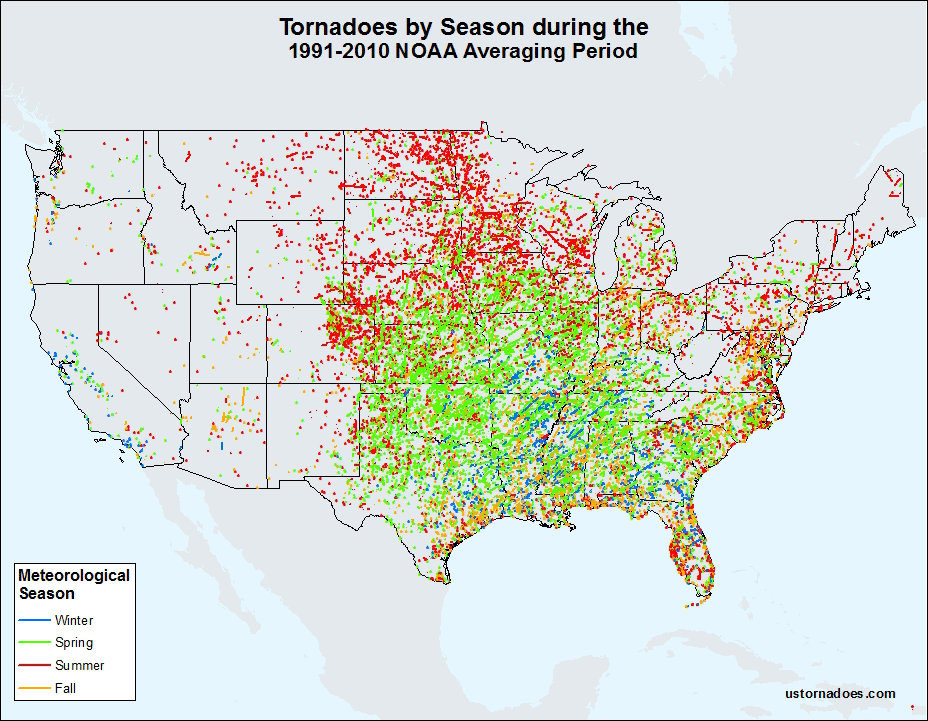
Spring is here! It's time to leave the mittens and heavy coats behind, enjoy the budding trees and blooming flowers, and also be aware of severe weather. That's right, springtime is tornado season across much of the United States. But it depends where you live. That's one of the many things I learned while researching my newest book, The Tornado Scientist: Seeing Inside Severe Storms. Tornadoes are storms of violently spinning air spawned from powerful thunderstorms. The storms that produce severe weather, including tornadoes, are powered by warm moist air rising up into the atmosphere. That's why winter twisters are rare in cold places like Minnesota but happen in the warmer South. This terrific UStornadoes.com map shows where tornadoes have occurred by season. What is the prime season for twisters where you live?
More importantly, are you and your students prepared for a tornado? Remember, a TORNADO WATCH means a tornado is possible ("watch" TV or other media for updates) while a TORNADO WARNINGmeans a tornado is likely happening ("warning": take shelter now). Here are some tornado safety tips from FEMA: BEFORE: Have a school and/or family plan. Everyone should know where to go and what to do. Make sure an emergency kit is stocked and easy to get to. DURING: Put on shoes, get the emergency kit, and go to basement, cellar, or a closet or hallway in the lowest level of building. Stay away from outside walls, windows, and doors. Protect your head. (Got a bike helmet?) AFTER: Watch out for broken glass and nails (shoes! not flip-flops) and never go near loose power lines. Text, don't talk to communicate to leave phone lines open for emergency workers. Use this simple quiz to start a conversation with students about staying safe during severe weather. It's part of a downloadable Tornado Fact Sheetfor kids from FEMA. Be safe and happy spring!
Happy New Year to you and happy new book to me! ☺ Mission to Pluto: The First Visit to an Ice Dwarf and the
Kuiper Belt is out January 10th. The book is about the first ever spacecraft
mission to visit Pluto and the surprising discoveries it made. The plucky
piano-sized probe New Horizons reached Pluto in 2015 after a 9½-year journey.
The book follows the team of scientists as they build, launch, and fly New
Horizons three billion miles to finally arrive at the Pluto system of an ice
dwarf planet and its five moons.
School's almost out and summer is nearly here! What better time for a road trip? No matter if you're headed off on a grand tour of America's national parks, or simply visiting relatives in a nearby town, allow students and children the opportunity to help with trip planning.
This summer the National Park Service (NPS) will turn 100 years old. Green-uniformed rangers in their iconic calvary hats started serving America in 1916. The National Park Service manages and protects some of the continent's most treasured places—from Acadia to Zion. Our national parks have been called “America’s best idea” andwelcome more than 270 million visitors each year.
I'm proud to announce my newest book! It's another installment in theScientists in the Field series called Inside Biosphere 2. It's about the terrific Earth science research going on inside this unique three-acre enclosed facility. The jumpsuit-wearing Biospherians for whom the huge greenhouse was built are long gone. Today, the University of Arizona owns the large-scale laboratory and its rainforest, ocean, and savannah habitats. A bevy of scientists are conducting experiments in these biomes, studying the effects of drought, rising temperatures, and other environmental factors.
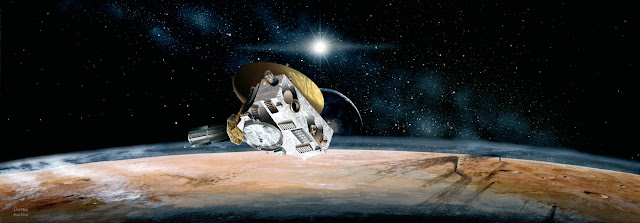
It's almost Pluto time! On Tuesday July 14th at 7:49AM EDT the first-ever spacecraft to visit Pluto will make its closest approach. New Horizons is a robotic spacecraft about the size of a grand piano. It left Earth way back in 2006 and has been speeding across the solar system ever since. After nine and a half years and three billion miles (that's billion with a B, folks), New Horizons is finally in the home stretch. Planetary scientists and astronomers are already collecting data and images never before possible. We will all learn lots of new amazing facts about Pluto, its big moon Charon, and the system's four little moons Nix, Styx, Kerberos, and Hydra. You'll be able to read all about the discoveries in my upcoming 2016 Scientists in the Field book, Mission to Pluto!
School is winding down and summer vacation is just around the corner! Many of us will pack up the car and take to the road, stopping at sites both new and familiar. Touring our national parks in the family car is akin to a rite of passage. Did you go from the Grand Canyon or Yellowstone as a kid? While I'm all grown up, national parks are still my favorite vacation destinations. In fact, my love of national parks inspired my latest book. Park Scientists: Gila Monsters, Geysers, and Grizzly Bears in America's Own Backyard has just been released! The book follows scientists working on six different projects in national parks—collaring grizzlies and studying geysers in Yellowstone, counting cacti and tracking Gila monsters in Saguaro, and studying salamanders and synchronous fireflies in Great Smoky Mountains.
The book involved lots of fantastic travel for myself and the photographer (my husband) Tom Uhlman.
He also took lots of video, which he made into the fantastic book
trailer above.
Park Scientists is a book in Houghton Mifflin Harcourt's Scientists in the Field series so has its own custom Discussion and Activity Guide written by curriculum consultant Ed Spicer and retired librarian Lynn Rutan. It includes Common Core connections and is free for download. There are lots of great activities in the Guide, as well as links to find out more. Here are a couple of my favorite activities from it, ones that can be used with a local park, too. Here's hoping your summer is filled with adventure and discovery!
Pre-Reading
Activity
Visit a local park. Take
an inventory of the natural resources within it. Why was this particular piece
of property chosen to house a park? Now visit a vacant lot or an area of land
without (or with very few) manmade structures. If we were in charge of granting
park status, would we select this lot as one to which we would grant it? Think
about any cherished outdoor spot. Is it within a park? What is it about these
spaces, particularly the ones that are not withinnot within a park, how would you feel about it being
designated a park? Is there a difference between personal favorite spots and
public spaces? Do they overlap? Why are some spaces parks and some not parks?
Applying and
Extending Our Knowledge
As you read through this
book, create a picture glossary, of the animals (and, if you’re feeling
ambitious, plants too) that are mentioned or shown.
• All national parks
change. Naturally occurring erosion, fires, earthquakes, etc., bring physical
changes to the park. Search for images of Yellowstone in the 1870s and in
regular increments of time up to today. Try to find images documenting the
exact same location. Write a narrative describing the changes over time to the
area.
• Indicate which ones are
found in all three parks, two parks, or exclusively in one park. Include
scientific name, common name, range, description, habitat, diet, and any
noteworthy facts (about behavior or endangered status, etc.). Group by families
and then alphabetically by scientific name.
• Assign groups of students
to catalog the animals in various national parks until the class has completed
a survey of all fifty-eight national parks. In looking at the collated list of
national park animals, which animals are most commonly found? What do we notice
about animals that are endangered or threatened?
Common Core
Connections CCSS.ELA-Literacy.W.7.1 Write arguments to support claims with clear reasons
and relevant evidence. CCSS.ELA-Literacy.W.7.2 Write informative/explanatory texts to examine a topic
and convey ideas, concepts, and information through the selection, organization,
and analysis of relevant content. CCSS.ELA-Literacy.W.7.7
Conduct short
research projects to answer a question, drawing on several sources and
generating additional related, focused questions for further research and
investigation.
When our book Emi
and the Rhino Scientistcame out in 2007 there were about 300 Sumatran rhinos
left on the planet. These small hairy rhinos live in the forests of the
Southeast Asian islands of Sumatra and Borneo. By the time we updated the book
for its 2010 paperback version, the species’ wild population numbers were down
to 200. Today, only half as many remain. How many will exist in another three
years? If a hundred more are lost, no Sumatrans will live in the wild at all.
None.
“What
does it say about humanity,” asks rhino scientist Terri Roth, “if we cannot
find a way to share the earth with such an ancient, peaceful, non-threatening
species like the Sumatran rhino.”
Sumatran rhinos are slaughtered for their small stubby
horns. Rhino poaching isn’t new. Rhino horn has long been valuable to hawkers
of traditional Chinese and Asian medicines. But the price of rhino horn
worldwide has skyrocketed in recent years. Demand for black market rhino horns
has never been higher in China and Vietnam. The growing affluence in these
nations has boosted the price of rhino horn. Rumors that powered rhino horn
can cure cancer and its use as a fashionable club drug for the very wealthy has
made the situation untenable. As the value of rhino horn has increased to surpass gold gram for gram, poachers
have become armed with high-tech weapons and night vision equipment. Wildlife
rangers are outgunned. Currently some fifty rhinos a month are being poached in
Africa alone.
While all rhinos are threatened, Sumatran rhinos are the
species most in danger of extinction. As an example of how desperate the
situation has become, Terri is going to try breeding two of Emi’s offspring.
Harapan has just returned to the Cincinnati Zoo. The six-year old male had been
living at the L.A. Zoo. Terri and the other scientists at the Center for
Conservation & Research of Endangered Wildlife (CREW) hope to breed him
with his older sister, Suci, who never left the Cincinnati Zoo. “No one wants
to breed siblings, it is something we strive to avoid,” explains Terri. But
with no other captive Sumatran rhinos available, inbreeding is a lesser worry
than extinction. “And I am not willing to sit idle and watch the last of a
species go extinct.”
Suci and her keeper Paul Reinhart (photo by Tom Uhlman)
Rhino mud wallow at the Cincinnati Zoo (photo by Tom Uhlman)
Kids love rhinos! Teachers can turn that enthusiasm into purpose-driven
persuasive writing. (It's Common Core!) They can join in the Cincinnati Zoo’s Letter Campaign for the Sumatran
Rhino.
And just for fun, below is an activity for making a rhino out of modeling clay.
It helps practice using a metric ruler, too. It's from a terrific conservation
organization, Save the Rhino. Check out
their For Kids - Save
the Rhino link for more.