Showing posts with label New Horizons. Show all posts

July 1, 2020

Mission to Pluto Update and Paper Spacecraft Model

 Mission to Pluto

Get your mission update! My book, MISSION TO PLUTO: The First Visit to an Ice Dwarf and the Kuiper Belt is now out in paperback! The reprint includes an update on the mission's perfectly fabulous first-ever flyby of a Kuiper belt object (KBO).

Kuiper Belt object Arrokoth.
The plucky piano-size spacecraft made history again in January of 2019 when it navigated a photo-snapping flyby of the KBO Arrokoth more than 4 billion miles from the Sun. The name means "sky" in the Native American Powhatan-Algonguian language. It's amazing to fathom, considering that when the New Horizons spacecraft flew by Pluto in 2015, Arrokoth hadn't been discovered yet! When images of Arrokoth reached Earth, scientists were stunned to learn that it wasn't a single object, but a two joined rounded lobes. It looks a bit like rust-colored snowman! Nothing like it has ever been seen anywhere in the solar system. The theory is that Arrokoth's two ball-shaped bits once orbited each other as binary worlds, not unlike Pluto and Charon do today. Something happened long ago that caused them to merge and stick together. Billions of years ago when the solar system was forming, lots of bis and pieces crashed and clumped together. It's how the planets were made. Arrokoth is like a snapshot of that process frozen in time. 

Unbelievably, there's still more to come! New Horizons is currently a healthy spacecraft and is furthering its journey into the Kuiper Belt. Want to learn more? 
  • Get caught up on the story so far, by reading my book Mission to Pluto. There's a great free downloadable educator's guide for the book, too.
  • There are tons of great resources for educators on the New Horizons website, including activities for K-12.
  • Check New Horizons' official website for further updates from the outer solar system.  pluto.jhuapl.edu
Go New Horizons, go!

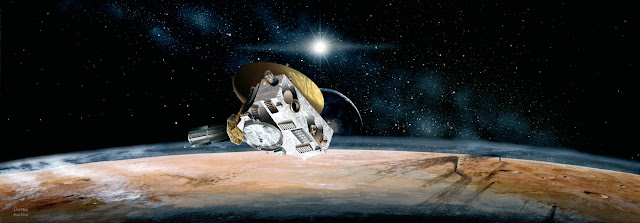
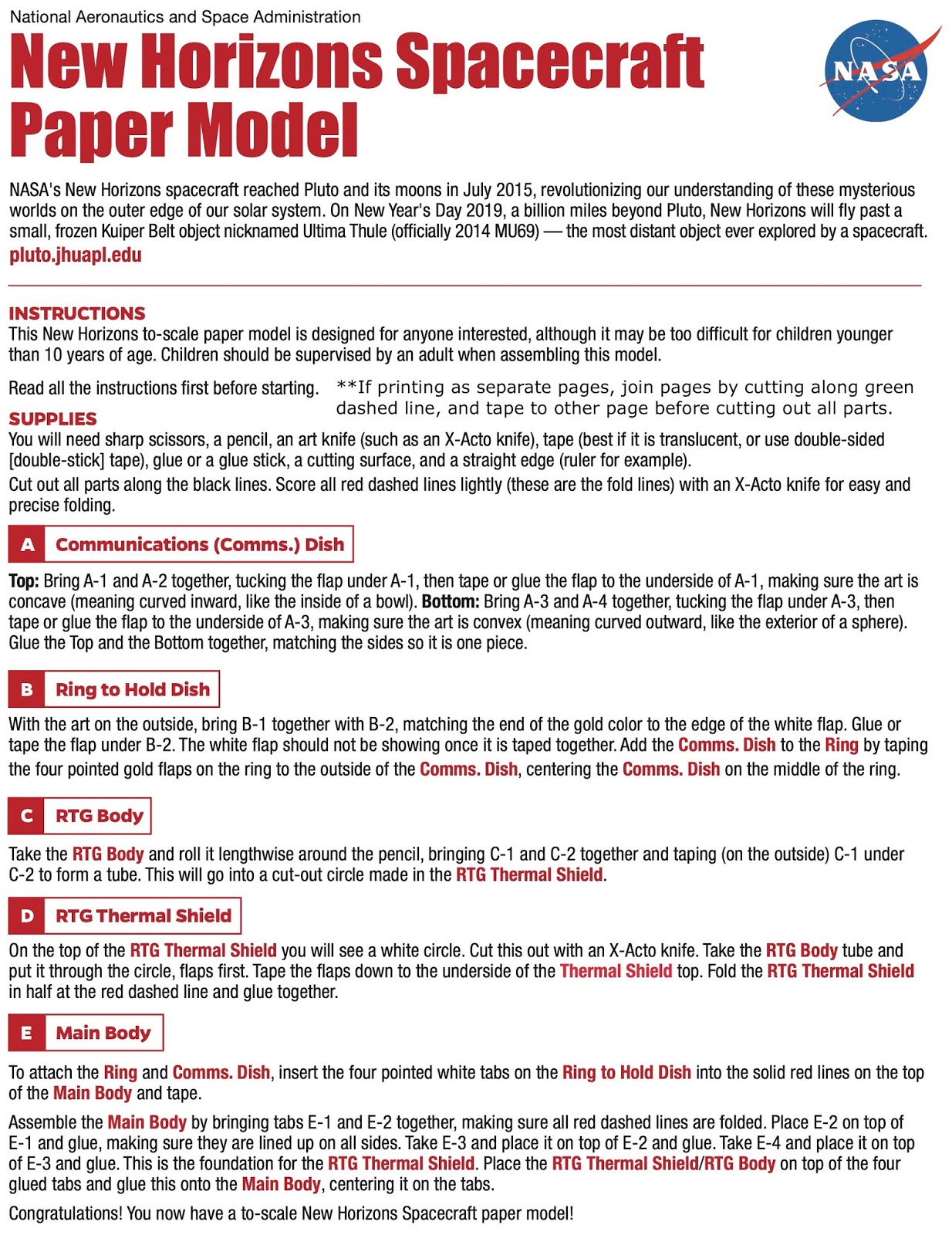
To celebrate, print out and assemble this fun NASA paper model of the New Horizons spacecraft. Enjoy!




November 30, 2018

Join the Ultima Journey

By Mary Kay Carson

The spunky spacecraft that became the first visitor to Pluto in 2015 is about to make history again. New Horizons is nearing its second stop, an icy object being called Ultima Thule. Meaning a place "beyond what is known" it's the perfect nick-name for this dark reddish chunk of ice and rock a billion miles past Pluto. Ultima Thule is a Kuiper Belt object, one of millions that orbit beyond Neptune that make up our solar system's outer zone.

After accomplishing its nearly ten-year journey to the Pluto system where it rewrote the book on the icy dwarf planet and its five moons, New Horizons headed toward the small Kuiper Belt object. The speedy grand-piano-sized robotic probe will reach Ultima Thule late this month on New Year's Eve. It will be the farthest planetary exploration by a spacecraft ever! The KBO is an astounding 4 billion miles from the Sun.


Here's how to make sure you're tuned into the action and how to get students up to speed on the mission so far, as well as some fun activities to share. 
  • Get caught up on the story so far, by reading my book Mission to Pluto. There's a great free downloadable educator's guide for the book, too.
  • There are tons of great resources for educators on the New Horizons website, including activities for K-12, a 3D model printing file, and a fun-to-make one-twentififth scale paper model that's available as a printable PDF.(You'll need the instructions, too.)
Watch these web and social media sites for more, including live links during the flyby event:
Also, here is an annotated activity to help students comprehend just how far away Ultima Thule is. It's from my book Exploring the Solar System. Go New Horizons, go!


July 8, 2015

Get Ready For Pluto!


By Mary Kay Carson 
 

It's almost Pluto time! On Tuesday July 14th at 7:49AM EDT the first-ever spacecraft to visit Pluto will make its closest approach. New Horizons is a robotic spacecraft about the size of a grand piano. It left Earth way back in 2006 and has been speeding across the solar system ever since. After nine and a half years and three billion miles (that's billion with a B, folks), New Horizons is finally in the home stretch. Planetary scientists and astronomers are already collecting data and images never before possible. We will all learn lots of new amazing facts about Pluto, its big moon Charon, and the system's four little moons Nix, Styx, Kerberos, and Hydra. You'll be able to read all about the discoveries in my upcoming 2016 Scientists in the Field book, Mission to Pluto